
Rich Evans, PE – Sr. Vice President Technical Functions and Bonnie Janowiak, PhD – Principal Chemist
You just received a laboratory analytical report for a recent stack test. There’s an exceedance of one of the permitted analytes. You begin to worry about the cost and scheduling of a resampling event, a notice of violation, or fine from the regulatory agency. However, do you know if your analytical results are accurate? You would if you had an effective quality assurance (QA) and quality control (QC) plan!
Environmental compliance decisions are only as good as the data supporting them. Regardless of whether you are monitoring air emissions, demonstrating compliance with a discharge permit, or monitoring groundwater, inaccurate or unreliable sampling data can lead to regulatory violations, unnecessary corrective actions, and costly investigations. Understanding the fundamentals of QA and QC is essential for asking the right questions before relying on laboratory analytical data and acting on analytical results.
Quality Assurance and Quality Control
Although the terms are often used interchangeably, QA and QC serve different purposes. QA consists of proactive measures designed to prevent errors before they occur such as staff training, written procedures, equipment calibration programs, and laboratory certifications. QC, on the other hand, consists of checks performed to evaluate whether errors occurred during sampling, handling, or analysis. Field duplicates, trip blanks, equipment blanks, and laboratory spike samples are all examples of QC measures used to verify data quality. Together, QA and QC provide confidence that sampling results accurately represent environmental conditions and can withstand regulatory scrutiny.
QC Measures
Collecting environmental samples without QC samples is common but can result in uncertainty in sample results. For example, consider a quarterly sampling event at a stormwater outfall that results in laboratory detection of a contaminant above the permitted limit at your facility. In the absence of appropriate QC information, you are uncertain if the data represents actual conditions or was affected by contamination or sampling error. A resampling event may provide an analytical result below the permit limit but may not eliminate reporting or averaging the original sample. What consequences may result?
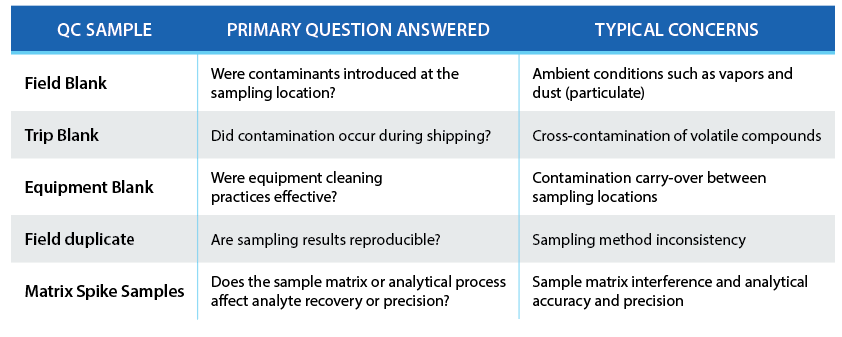
QC samples may identify if samples results are valid or if errors occurred in the field or laboratory that affected the laboratory analytical results and can be used to confirm the accuracy of samples as well as potentially explain anomalies or unexpected laboratory results. The following table highlights the purpose of common QC sample.
QC Sample Best Practices
QC samples are an important way to ensure quality in sampling. Before your next compliance sampling event:
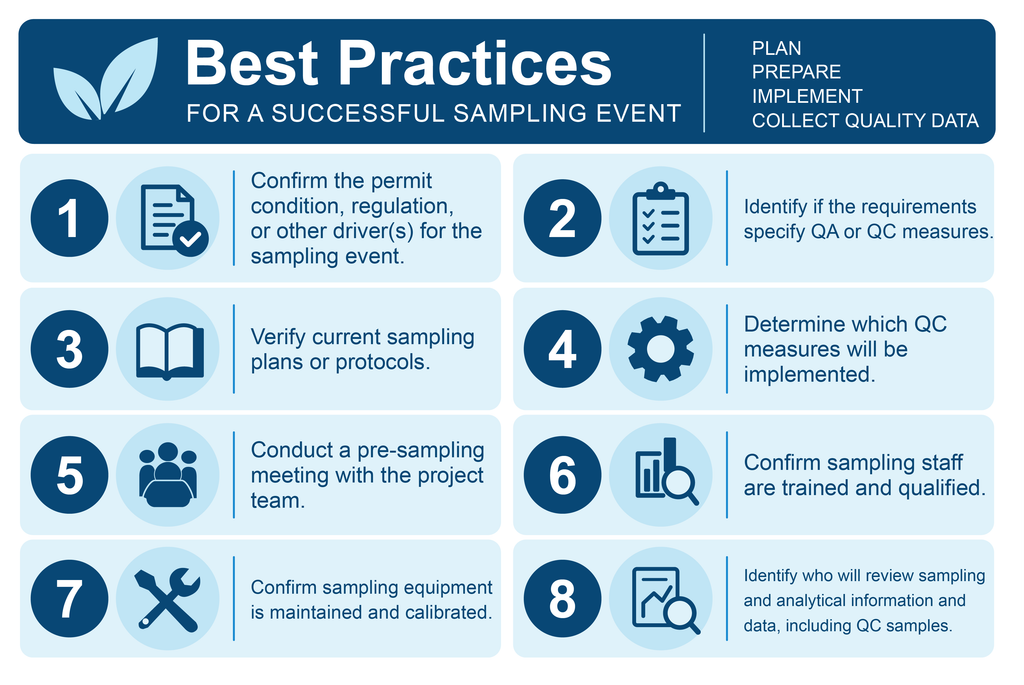
Environmental compliance managers do not have to be laboratory experts, but they should understand the types of QC measures, why they are being used, and what risk(s) each address. An effective QA/QC program helps make compliance data more reliable, accurate, and defensible. Ensure that quality is part of your environmental compliance program!